Testing the public's patience
Even if the electorate is short-termist, it's hard to argue irrational public impatience is to blame for the prime minister's woes

The ongoing manoeuvring to challenge Keir Starmer for the leadership of the Labour Party, and thereby the job of prime minister, has sparked a debate about what has caused his demise: governability, or governing. Simply put, this is a disagreement between political commentators about whether the British public is so impatient as to make any prime minister’s job impossible. Or whether perhaps, instead, the prime minister has just done a bad job.
I have done quite a lot of research into the apparent short-termism of the British public, which can inform this debate. But it’s important not to jump too hastily to conclusions as to what the findings tell us about the structure of the government’s problem.
First of all, what even is the short term in politics, as far as voters are concerned? In research with my colleagues Philip Cowley and Karl Pike, I have shown that British voters think of the “short term” as meaning roughly around two (one to three) years. In other words, about half a parliament—half the time a government is supposed to get to make changes before it stands for re-election. As Philip wrote in the Financial Times after we published that study,
[R]eal change in what the public see as the short-term… is… difficult to demonstrate. This is a problem for most politicians. But it seems to me to be especially a problem for this government, which has — ostensibly, at least — swept in promising change and then pitched a politics of patience, with short-term pain for long-term gain.
But have voters really been expecting this government to deliver change within that short term? Essentially, yes. In later research, reported in PoliticsHome, we found that on average the public was expecting noticeable improvements in the NHS and schools within two years, and in housing within three years.
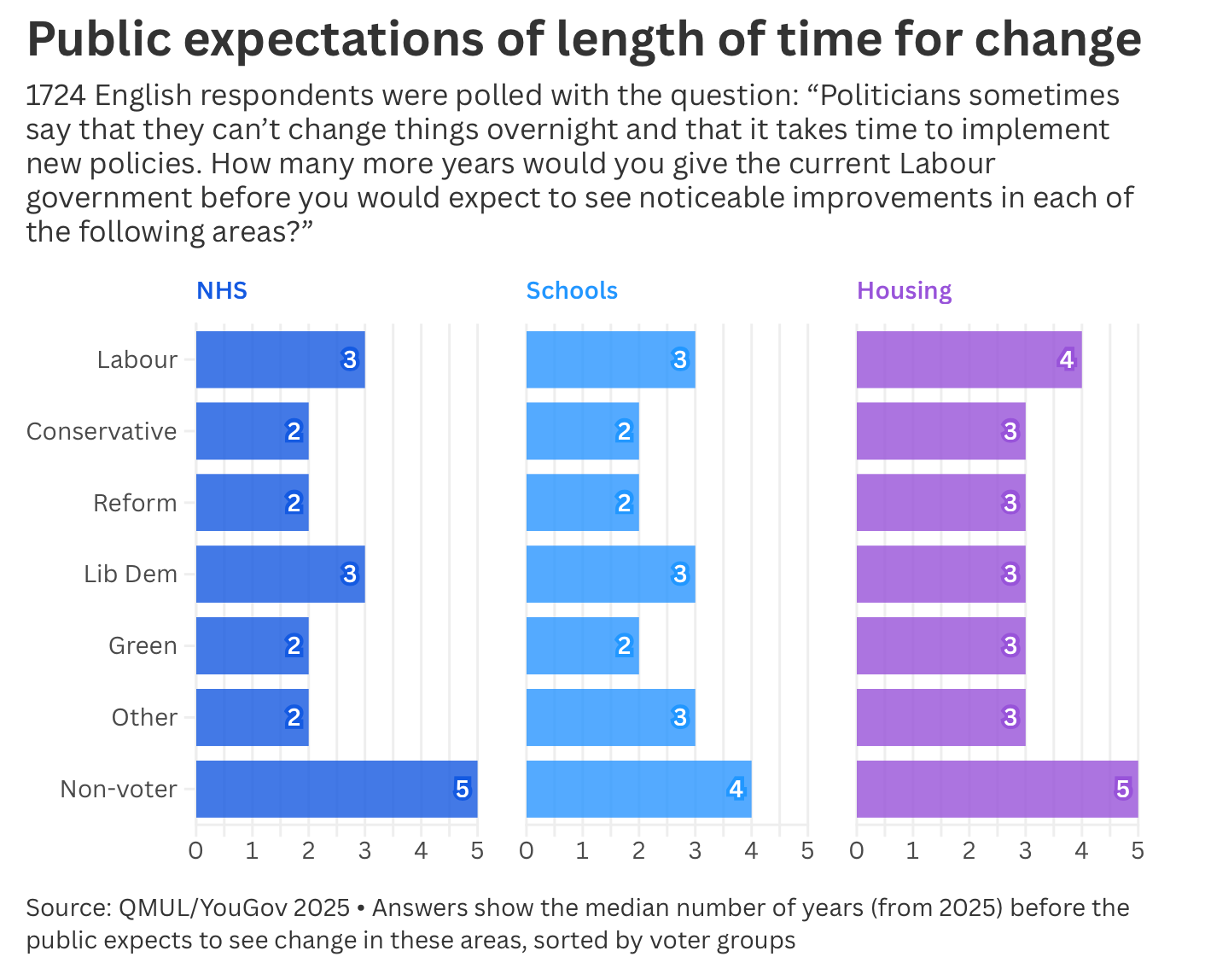
Immediately here, it seems like we have very clear evidence for the impatient public argument. It takes time to make significant improvements to public services that are in a precarious state.
But then, think about what the electorate was told to expect. There were supposed to be 1.5 million new homes built by the end of the first parliament. If you tell us you are going to build 1.5 million homes in five years, then we are going to expect to start noticing improvements in housing within three years—in fact, people expected it within four years or more, if we factor in that we asked people this almost a year into the government’s term. Incidentally, whether the target will be met is questionable.
Then there is the NHS. Wes Streeting—who has just resigned as Health Secretary to put pressure on the prime minister—promised, among other things, to hit national targets for A&E waiting times, ambulance response times, and cancer waiting times by the end of this parliament. If you’re promising to do all that over five years, it’s reasonable of us to expect to notice things improving beyond about halfway through that time. Of course, Streeting went on to admit reaching all these targets at once would be impossible. But let’s not put too fine a point on it.
Something worth noting here is that public patience in these areas varied slightly according to people’s politics. Labour’s 2024 voters, for instance, were willing to allow the government about a year longer than Reform voters were, on average.
And yet, it is well known that many of Labour’s 2024 voters have been jumping ship to plump for other parties. In another later study reported by the Financial Times, we found that Labour was losing support at an especially alarming rate among its voters who are more orientated towards the short term in their political decision-making. That is, the more a 2024 Labour voter tends to focus on the short term when voting or just thinking about politics in general, the more likely they are to have abandoned Labour since. More long-term political thinkers were more likely to have remained loyal to the government. Although, even they were far from sticking around in great numbers.
That last point is perhaps unsurprising for a government that, from its outset, has been playing up its long-termist credentials. As I summarised here, a lot of research illustrates that voters in principle prefer policy outcomes to be delivered sooner rather than later. So governments that are telling people they will have to undergo short-term pain for long-term gain might not enamour electorates.
However, for one thing, the consensus in this academic literature is not that this preference represents any kind of irrational impatience. It is instead more that uncertainty around whether outcomes will really be delivered increases the more long-term those outcomes are, so voters rationally discount those benefits the further into the future they are said to emerge. It makes total sense.
And for another thing, people take that risk more readily if the benefit is big enough. When I presented British research participants with hypothetical policy proposals with different scales of societal outcomes over different time frames, they were willing to accept a delay in delivery when they had good reason to expect the (undeniably positive) benefits to be very large. To me, that also makes total sense.
So we should ask ourselves, do voters have good reason to expect what the government has been doing so far, in the name of short-term pain for long-term gain, to deliver big, positive benefits to society in the long term? Does a budget that plans a load of spending cuts towards the end of the parliament scream ‘long-term gain’? Does skirting around manifesto promises not to raise taxes on ‘working people’ by increasing employer National Insurance contributions promote the kind of economic growth (the government’s apparent number one priority) that will bring ‘long-term gain’? What about punitive changes to migration and asylum policy? Or refusing to consider exploring re-entering the European Customs Union?
The point isn’t that these ideas are all necessarily wrong on their own terms, nor to deny the government has tried to do some things that more concretely inflict short-term pain for long-term gain. You could certainly argue that the government’s forays into major welfare reform and means testing winter fuel payments were the kind of thing they had in mind when pitching the politics of patience. Rein in spending in these areas, and shore up the public finances, to get the economy on a stable footing for future growth, and so on and so forth. But the broader point, that the policy programme as a whole has not conformed to this short-term pain for long-term gain logic, still stands.
Political pressure prevented these latter changes from working out as originally intended, so maybe it’s not the government’s fault after all? Maybe the public says it’s willing to accept short-term pain for long-term gain, but when reality bites, they can’t handle it? If so, that’s not primarily about impatience.
I would argue, instead, that there is a further underlying problem of inconsistency: an inconsistency of political vision. Many commentators have pointed out that the government, and Keir Starmer at its helm, lack any sort of clear argument or story about where they are trying to take the country. As I have put it elsewhere, they lack a future:
Keir Starmer talks about getting the country’s future back, building services that are fit for that future… But at no point is it clear what, in general, that future is imagined to be like, in terms of the values and principles that future society should represent—where we are really trying to go, beyond somewhere supposedly better… Its empty invocation of the future leaves the Labour government unable to make compelling arguments in support of its policies. Announcements like the recent change to the asylum system confound commentators precisely because they are not presented in terms of a consistent political argument. The pre-Budget flip-flopping on income tax was the result, too, of policymaking that is not convincingly cast as part of a process towards the realisation of some principled vision.
Not only has the government tried to do some things that fit the short-term pain for long-term gain structure, and many others that do not. But also, when it has done so, it is not clear how that long-term gain, the future the policies create, aligns with the kind of future the government envisions for society overall. That’s what a coherent ideology, a political vision, a consistent argument would give the government: a promise of what society can be and why we should want that, a reason to want the long-term gain for which we apparently undergo short-term pain. But then it’s also not clear how any such vision could possibly be constructed to make sense, simultaneously, of all this current government’s policies on welfare, migration, healthcare, climate change, housing, and so on.
And absent any such argument, of course voters are left wondering where the change is, why it hasn’t come yet, and what it’s even supposed to look or feel like. That’s all they’ve been told to expect: things to be better somehow. If things aren’t somehow better, they have nothing to judge the government on except its apparent failure to deliver for them. And if, when they search for that substance, they instead find inconsistency—and, frankly, bad vibes—why would the electorate keep believing in the government?
Yes, voters prefer good things to happen soon. But who wouldn’t? Yes, they expect delivery in short timeframes. But weren’t they told to? And yes, they sometimes balk at potentially expedient but punitive policies. But what is the cause in the name of which they are supposed to accept them? The way I see it, the argument that the public’s irrational impatience makes it ungovernable can’t be defended rigorously because it simply hasn’t been put to the test.
Starmer described his government as a “10-year project of renewal” when they won the election in 2024, yet some people consider virtually broken sections of our economy to be fixed not only in a single term but way before it's scheduled to end in 2029.